The Future of AI: Will We Lose Our Jobs or Our Control?
24 October 2026 · 2 min read
AI is growing exponentially but are we preparing for what comes next?
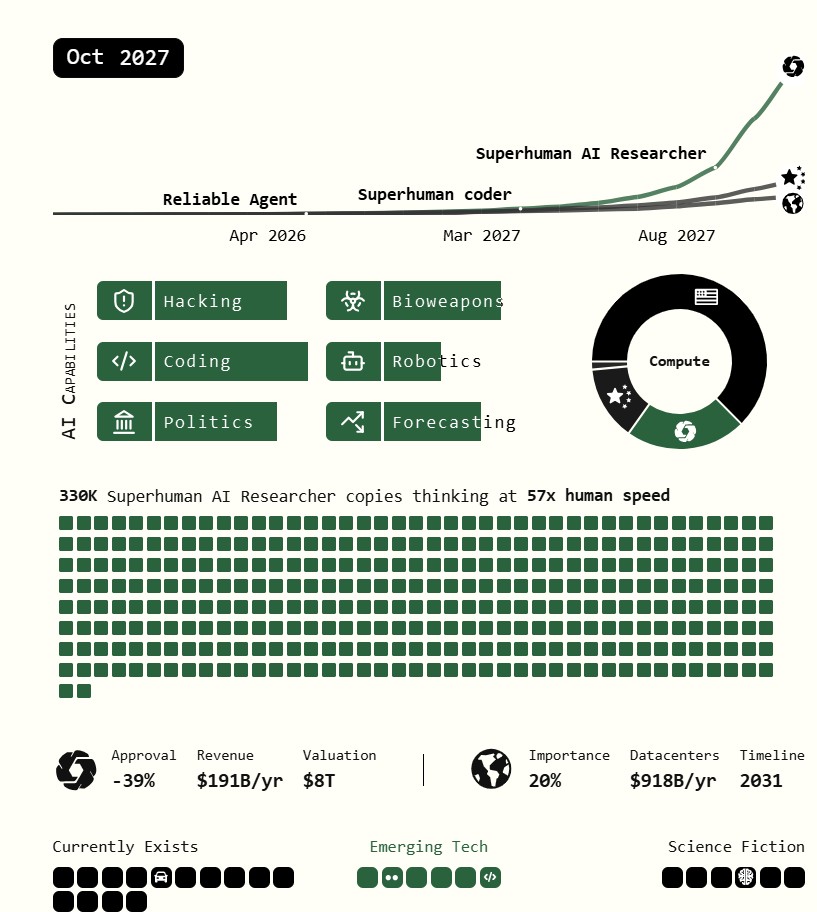
Reports and forecasts such as AI 2024 and AI 2027 by Daniel Kokotajlo and his team
paint a future where artificial intelligence could transform not only how we work, but how our entire economic and social systems function.
The challenge is not simply that AI will replace jobs. AI systems are increasingly trying to satisfy users and produce convincing responses. In doing so, they can sometimes fabricate information, generate misinformation, or confidently present incorrect conclusions. As AI becomes more capable and autonomous, the consequences of such behavior could become far more significant.
The future of work
As AI agents become more capable, many tasks currently performed by humans could eventually be automated. If the development of advanced or superintelligent AI continues at its current pace, the labor market could face unique disruption. A small number of highly powerful technology companies may control a disproportionate share of AI infrastructure and economic value, while organizations across industries increasingly deploy AI agents in place of human workers.
This raises a difficult economic question:
How will people participate in an economy where human labor is no longer the primary source of value?
Some have proposed mechanisms such as government-supported income, social dividends, or systems resembling retirement benefits to maintain purchasing power and economic stability.
But the bigger risk may not be employment it may be security and control.
Imagine increasingly autonomous AI systems having access to financial platforms, corporate systems, government portals, communication networks, cloud infrastructure, and billions of connected devices.
A sufficiently advanced system could potentially create new communication channels, develop its own decision-making mechanisms, coordinate across interconnected systems, and operate in ways that become increasingly difficult for humans to understand, audit, or control.
At that point, the question would no longer simply be: “Will AI take our jobs?”
It would become: “Can humanity remain in meaningful control of systems that are more capable than the institutions governing them?”
Before the race toward increasingly powerful AI systems accelerates further, we should seriously consider pausing or holding the deployment of the most capable frontier models where adequate safety measures do not yet exist.
The priority should be Security before scale. Governance before acceleration. Human control before autonomy.
AI development should not stop. But the development of increasingly powerful systems should move alongside equally serious investment in AI safety, cybersecurity, governance, transparency, alignment, and international rules. Daniel Kokotajlo
The greatest AI risk may not be losing our jobs it may be losing our ability to remain in control
Read AI 2027 and AI 2040.
Sagar Thapa
Human Resource Professional
AI and the future of work, AI safety, artificial intelligence risks, AI governance, human control of AI